
Monthly premiums for covering a companion animal arise from a combination of risk assessment and policy design. Insurers estimate the probability and expected cost of future veterinary care, then allocate those expected expenses across policyholders while adding administrative load and underwriting margins. Elements such as the pet’s health profile, projected frequency of claims, and the scope of services included in a plan are typical drivers of the monthly charge. Legal or market conditions in a given region, as well as the insurer’s pricing model, can also affect how much an owner pays each month.
Several categories of factors commonly shape how much an owner may pay for coverage. Pet-specific variables—age, breed, sex, and pre-existing conditions—interact with policy-specific choices like reimbursement percentage, deductible type, annual or lifetime benefit caps, and optional preventive care add-ons. Operational elements such as waiting periods, claim filing processes, and multi-pet discounts tend to influence premium levels indirectly by changing expected claim behavior or administrative costs. Understanding these components helps explain differences in monthly pricing across plans and insurers.
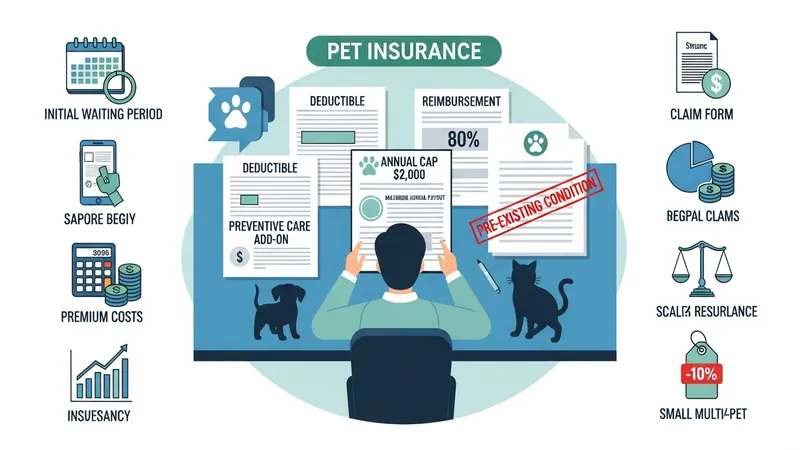
Age and breed are often primary determinants of premium variation. Younger animals may attract lower monthly rates because they typically present fewer immediate health issues, while older pets commonly see progressive increases in premium as the expected frequency and cost of claims rise. Certain breeds are statistically more susceptible to inherited conditions; insurers may use breed-specific morbidity and mortality data to adjust pricing. Owners should note that historical health events recorded as pre-existing conditions can limit or exclude coverage and that underwriting practices around such records differ between providers.
Coverage choices such as reimbursement percentage, deductible level, and annual or lifetime benefit limits interact directly with monthly pricing. Higher reimbursement levels and lower deductibles usually correlate with higher premiums because the insurer expects to pay a larger share of each claim. Similarly, policies with unrestricted or lifetime aggregate benefits may require higher monthly contributions than time-limited or per-incident capped options. The structure of deductibles—annual versus per-incident—also changes the insurer’s exposure and therefore can affect quoted monthly costs.
Reimbursement structure and cost-sharing design can change expected out-of-pocket timing for an owner while simultaneously shaping premium amounts. Reimbursement is commonly expressed as a percentage of eligible veterinary bills after the deductible (for example, a policy may reimburse a portion of covered costs). Choosing a lower reimbursement percentage or a higher deductible may reduce monthly premiums but increase cost-sharing when care is needed. Conversely, more generous reimbursement settings typically result in higher regular payments.
Policy-related mechanics such as waiting periods, exclusions, and definitions of covered conditions play a role in premium calculation because they alter the short-term and long-term risk profile. Waiting periods reduce near-term claim likelihood, which can permit slightly lower introductory rates in some programs. Specific exclusions—for example, congenital or hereditary conditions—limit insurer exposure to high-cost items and therefore influence pricing. Administrative features like digital claims submission or in-network partnerships may yield operational efficiencies that appear modestly in premium formulations.
In summary, monthly charges for companion-animal coverage reflect an interplay among pet characteristics, the breadth and mechanics of chosen coverage, and insurer-specific underwriting practice. Individual factors such as age and breed often interact with policy design choices—deductible, reimbursement, and benefit caps—to determine a final premium. The next sections examine practical components and considerations in more detail.
Different policy archetypes influence monthly prices through the scope of covered events and the temporal nature of benefits. Lifetime coverage, which may reimburse ongoing conditions over a pet’s life, typically requires higher ongoing premium contributions relative to time-limited or per-incident policies because the insurer anticipates recurring payments. Time-limited plans restrict the payout window for a specific condition to a set period, which can lower monthly premiums. Accident-only plans generally have lower premiums because the covered event set is narrower. Understanding these structural distinctions helps clarify why similar-sounding plans can have different monthly costs.

Reimbursement levels and deductible formats are central coverage elements that affect premiums. Reimbursement may be offered in tiers (for example, typical ranges may include moderate to high percentage levels), and deductibles can be annual or per-incident; both choices alter insurer liability. For example, an annual deductible spreads the owner’s cost across any claims during a year, while a per-incident deductible applies separately and can increase insurer exposure to frequent but small claims, which may be reflected in higher monthly pricing. Insurers use these mechanics to balance premium income against expected claims.
Optional add-ons such as wellness riders, dental coverage, or behavioural therapy inclusions usually appear as modular elements that incrementally affect monthly cost. Routine care riders for vaccinations and preventive exams are often priced separately from core accident-and-illness coverage; because these add-ons reduce the need for separate out-of-pocket budgeting for routine items, they may be chosen despite raising regular payments. Buyers frequently evaluate whether the incremental monthly amount for such riders aligns with their typical annual preventive spending patterns.
Contractual definitions and exclusions shape how broadly a policy responds to veterinary bills and therefore influence pricing. Clear definitions of pre-existing conditions, hereditary or congenital conditions, and elective procedures narrow or widen insurer exposure. Insurers apply actuarial data to anticipated claim types defined by these policy terms; plans with broader, more inclusive language typically require higher premiums because the expected payout frequency and severity increase. Assessing contract language offers insight into why price differences may exist between plans that appear similar at first glance.
Individual pet attributes that insurers commonly consider include age, breed, sex, reproductive status, and medical history. Age often produces a predictable effect: premiums may be lower for young animals and tend to increase as a pet moves into middle and senior years due to rising incidence of chronic conditions. Breed-related risk assessment commonly reflects population-level data on inherited conditions; certain breeds may be associated with higher expected veterinary costs. Spaying or neutering status and recorded prior conditions can also be factors evaluated during underwriting or quoting.
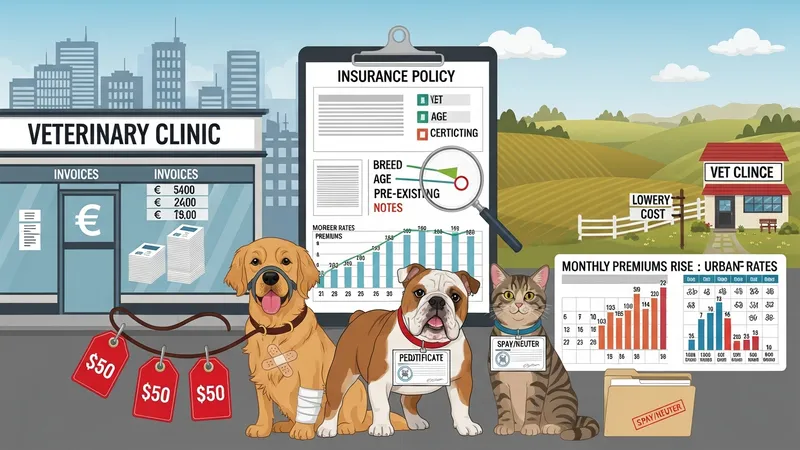
Geographic location and local veterinary cost structures may lead to regional variation in monthly pricing. Areas with higher average veterinary fees, higher cost of living, or greater prevalence of certain conditions can translate into higher insurer exposure and thus elevated premiums. For example, urban centers with more specialized veterinary services often report higher average visit costs than rural areas, which insurers may factor into regionalized pricing models. These geographic differentials are a common source of variation for otherwise similar policies.
Population density and pet demographics in a region can influence insurers’ portfolio-level risk and pricing decisions. Insurers monitor claims frequency and costs within defined territories; where claim incidence is higher, average premiums in that territory may be adjusted upward over time. Seasonal patterns or disease prevalence in particular regions—such as vector-borne illnesses in certain climates—can contribute to geographic pricing differences. Owners should recognise that location-based factors are typically one element among several in premium calculation.
Underwriting practices and available plan options often vary across markets, reflecting regulatory frameworks and competitive conditions. Some markets commonly offer multiple deductible and reimbursement tiers, while others emphasize simpler product structures. These supply-side differences can alter monthly pricing by changing how risk is pooled and priced. Understanding the interaction between pet attributes and local market structure helps explain why identical coverage names may result in different monthly payments across locations.
Deductible choices are a primary tool to manage monthly premiums; selecting a higher deductible typically reduces an insurer’s expected per-claim outflow and may correspond to lower monthly payments. Deductibles can be structured annually or per-incident, and that framing changes the owner’s exposure profile. Insurers price each structure differently because per-incident deductibles may lead to smaller claims being processed more often, altering administrative cost expectations and potentially affecting premiums.
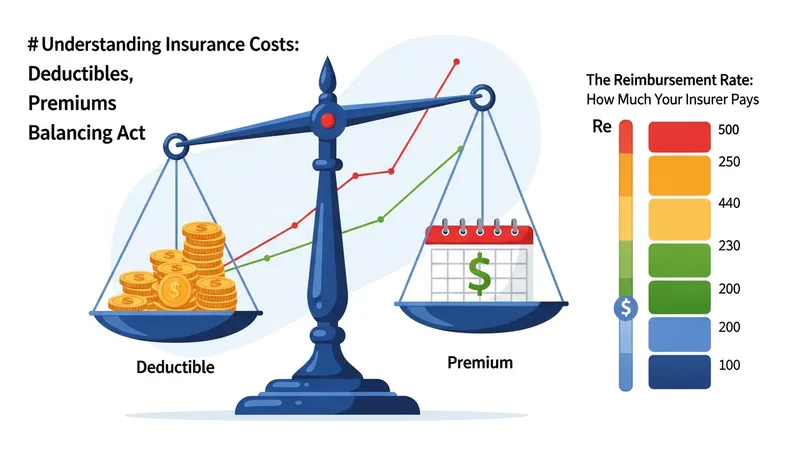
Reimbursement rates determine the share of eligible costs an insurer will cover after the deductible is applied. Typical reimbursement tiers may range broadly (for example, lower to higher percentage bands), and higher reimbursement percentages are associated with higher monthly premiums because the insurer expects to bear a larger portion of approved claim costs. The interplay between deductible level and reimbursement percentage shapes both monthly premium and expected out-of-pocket exposure when a claim occurs.
Benefit limits—including annual, per-condition, or lifetime maximums—affect pricing by capping insurer liability over defined periods. Policies with generous or unlimited benefit frameworks generally require higher monthly contributions because they leave the insurer open to ongoing high-cost claims. Conversely, time-limited or per-incident maximums reduce the long-term claim exposure and may be reflected in lower monthly rates. Evaluating these limits helps clarify trade-offs between premium level and potential long-term financial coverage.
Policy renewal practices and indexed pricing clauses also influence ongoing monthly costs. Some insurers adjust premiums over time based on claims experience, pet age, or broader cost inflation in veterinary care; these mechanisms may lead to stepwise changes in monthly payments at renewal. Transparency in how renewals are calculated contributes to clearer expectations about future monthly costs, and understanding typical renewal drivers can be an important consideration when comparing long-term premium trajectories.
Waiting periods and exclusion clauses modify near-term coverage and therefore influence the effective value of a policy relative to its monthly price. Waiting periods delay the ability to claim for certain conditions and are commonly used to prevent immediate claims on recently issued policies; this practice can slightly adjust initial pricing but is primarily a risk-control measure. Exclusions for pre-existing or congenital conditions limit insurer outflow and shape premium levels by narrowing covered claim types.

Claims process efficiency and administrative practices indirectly affect premiums through operational cost impacts. Faster electronic claims handling, clear documentation requirements, and transparent reimbursement timelines can reduce administrative overhead for insurers and may modestly influence premium structure. Conversely, policies that require more extensive vetting or manual processing can elevate insurer costs, which can be reflected in monthly pricing spreads across available products.
Behavioral patterns such as frequency of veterinary visits for preventive care, regional disease prevalence, and owner tendencies to seek diagnostics influence the claims experience and aggregated portfolio costs insurers use for pricing. Owners who routinely seek higher levels of diagnostic testing or specialist interventions may generate higher average claim sizes, which is reflected at the portfolio level in insurer pricing decisions. These behavioural and regional usage patterns are typically considered in actuarial projections underlying monthly premiums.
Practical cost-management considerations include selecting deductible and reimbursement combinations that align with anticipated care spending, evaluating wellness add-ons for expected routine expenses, and reviewing renewal terms for potential adjustments. Insurers’ historical claim data and sample pricing models can provide context for typical premium movement, but individual experience will vary. The final cost to an owner is the result of a blend of pet-specific risk, chosen policy design, and market-level pricing practices.